Consumer Staples Under Pressure: What’s Happening Beneath the Surface of XLP
As of: October 7, 2026
Consumer Staples are traditionally considered one of the more defensive areas of the equity market. That is exactly what makes the sector’s current development so interesting: while XLP has moved significantly below its recent high, market breadth beneath the surface has deteriorated as well. At the same time, however, parts of the sector are beginning to look considerably more interesting from both a fundamental and valuation perspective than they did just a few months ago.
The current setup is therefore neither simply bullish nor bearish. Instead, we are looking at a sector that remains under technical pressure and where weakness has become relatively broad – while valuations, particularly outside the largest companies, have compressed significantly and earnings estimates continue to point toward growth over the coming quarters.
The Technical Trend Is Starting to Crack
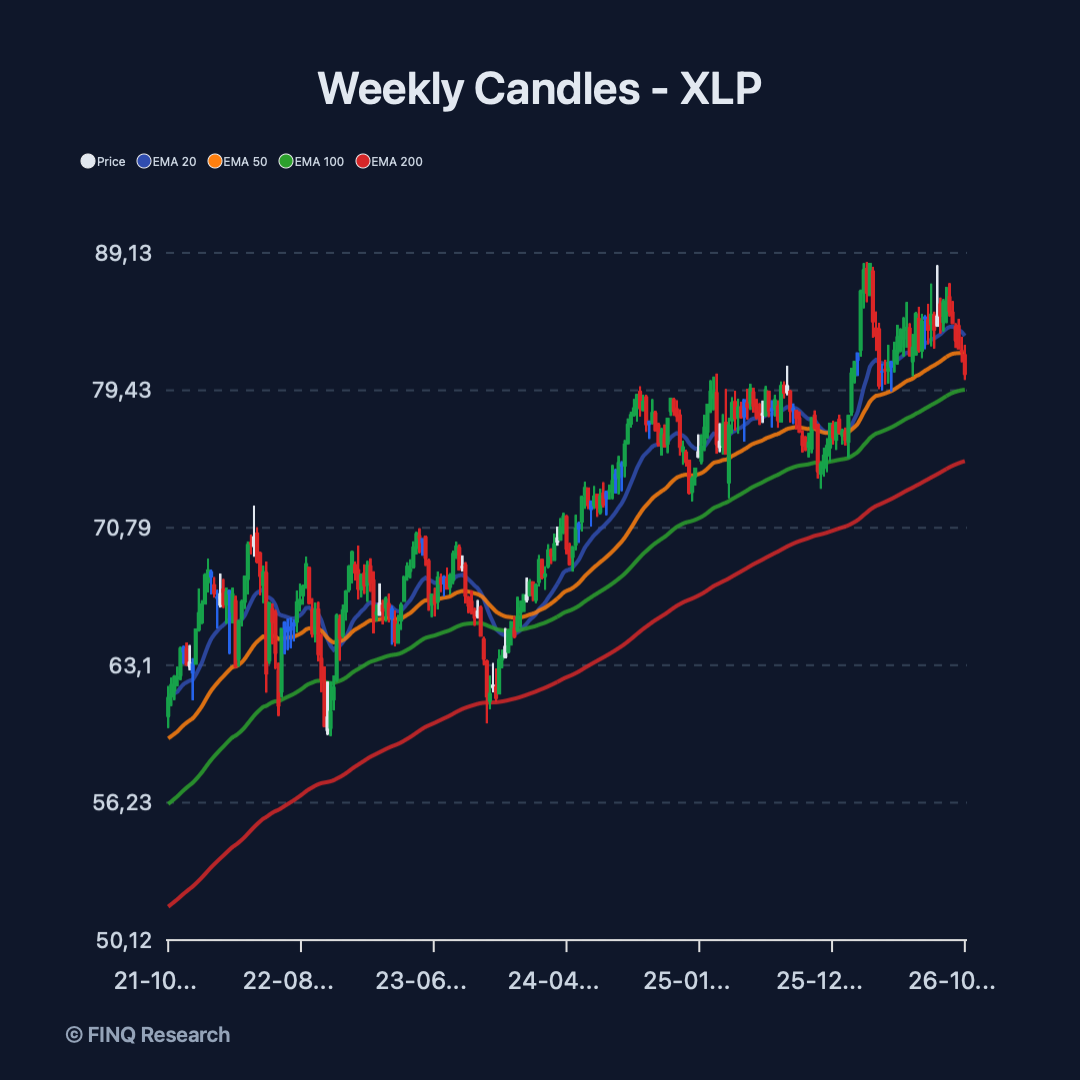
On a weekly basis, XLP’s long-term uptrend remains broadly intact. The ETF continues to trade well above its 200-week moving average. In the short term, however, the picture has deteriorated.
The price has recently fallen below its faster moving averages and is now approaching the area around the 100-week EMA. This puts the sector at an interesting technical point: the long-term trend has not yet been broken, but the shorter-term trend structure has clearly weakened.
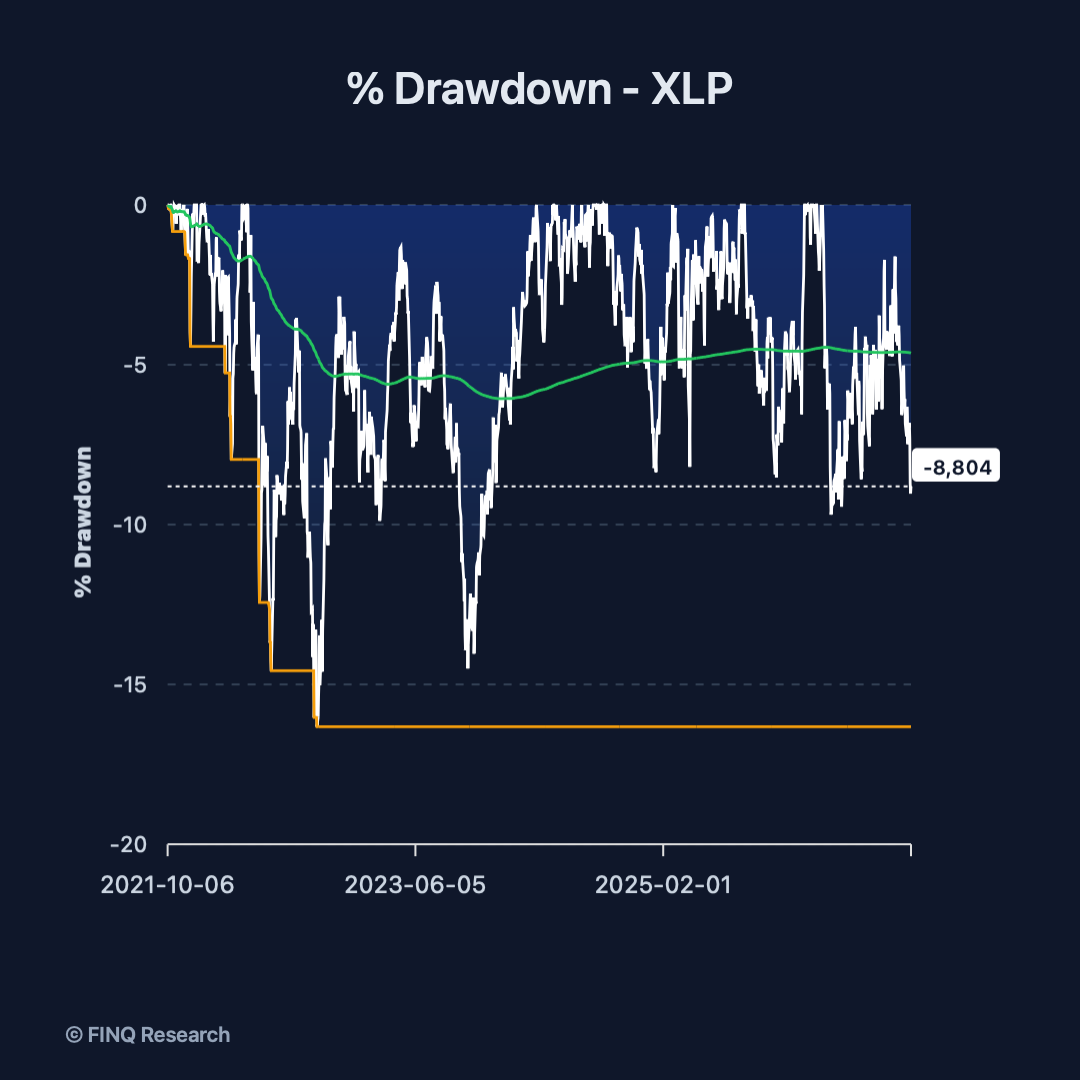
The drawdown also shows that this has become more than just a minor consolidation. XLP is currently trading around 8.8% below its previous high. The decline is considerably deeper than the average drawdown of recent years, while still remaining clearly below the larger corrections of roughly 15–16% that occurred during the period shown.
That makes the current area interesting: the sector has already experienced a meaningful pullback, but it has not yet reached a historically exceptional level of stress.
Weakness Has Become Broad
The development beneath the surface of the sector is particularly notable.
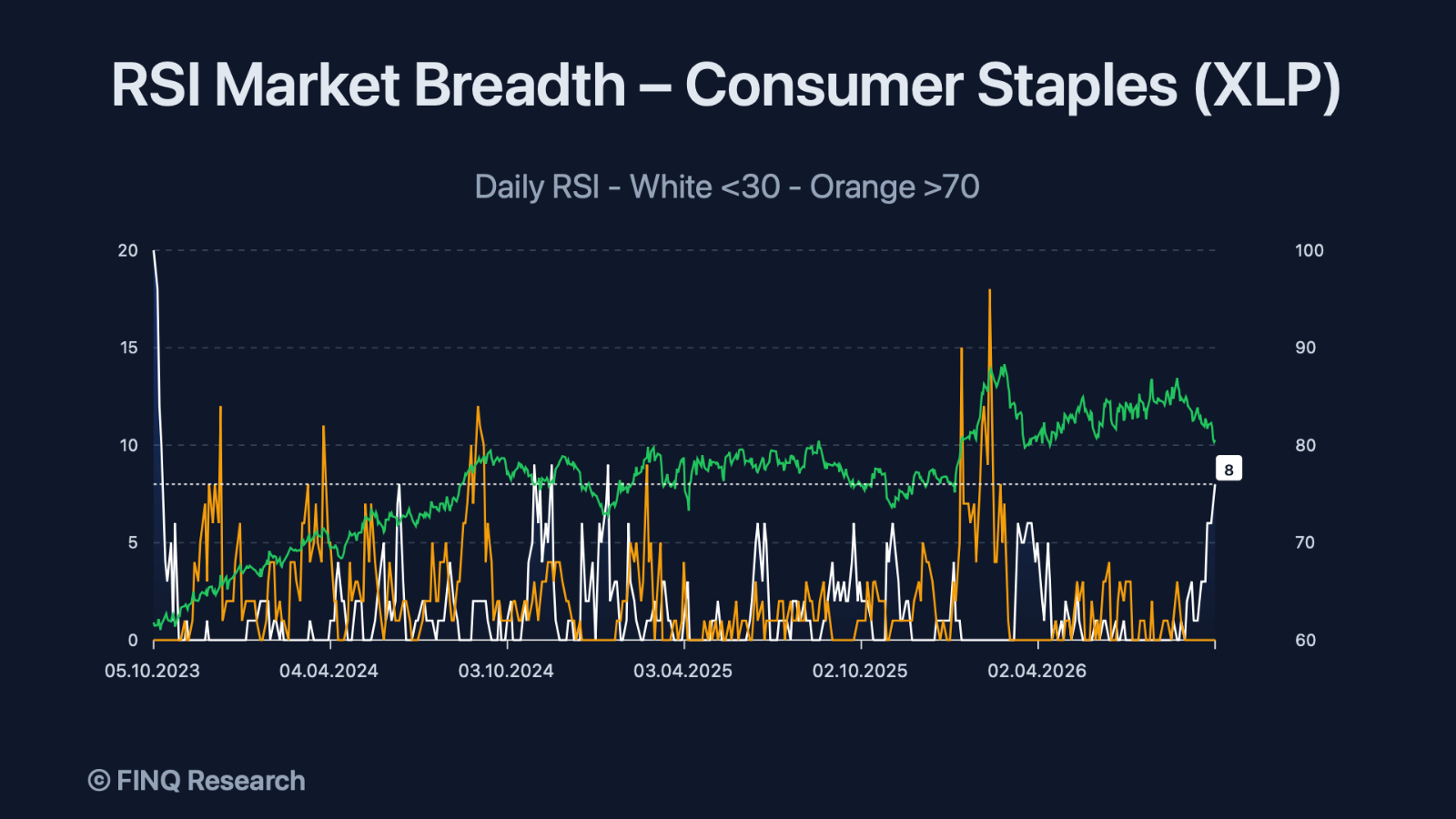
Currently, eight XLP constituents have a daily RSI below 30, while virtually no stocks remain above an RSI of 70. Just a few months ago, the picture was considerably more balanced.
Short-term weakness is therefore no longer limited to a handful of individual companies.
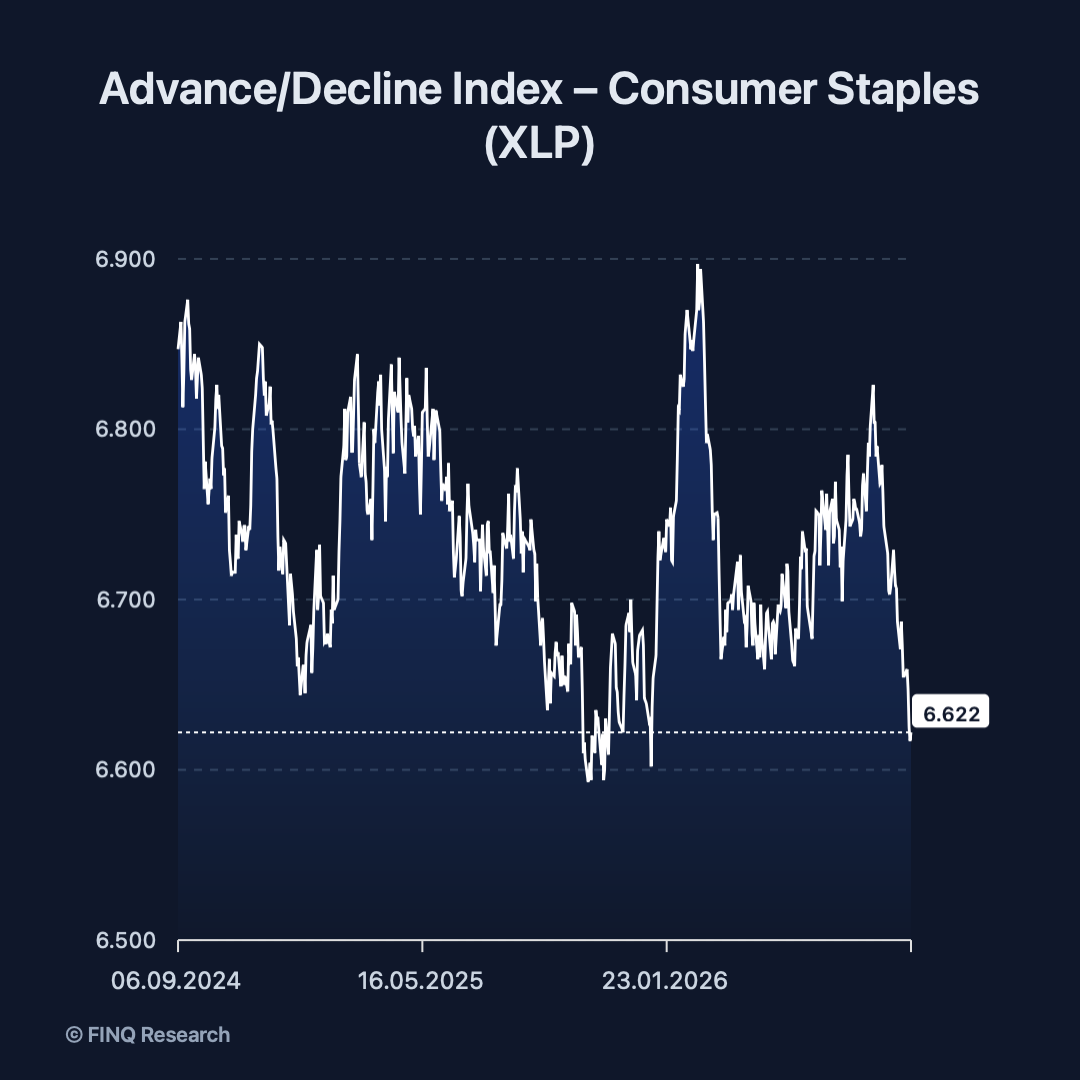
The Advance/Decline Index is sending a similar signal. After an interim recovery, the index has fallen sharply again and, at around 6.62, is back near the lower end of its recent trading range.
The ETF’s headline price performance therefore currently understates just how weak the move beneath the surface of the sector has become.
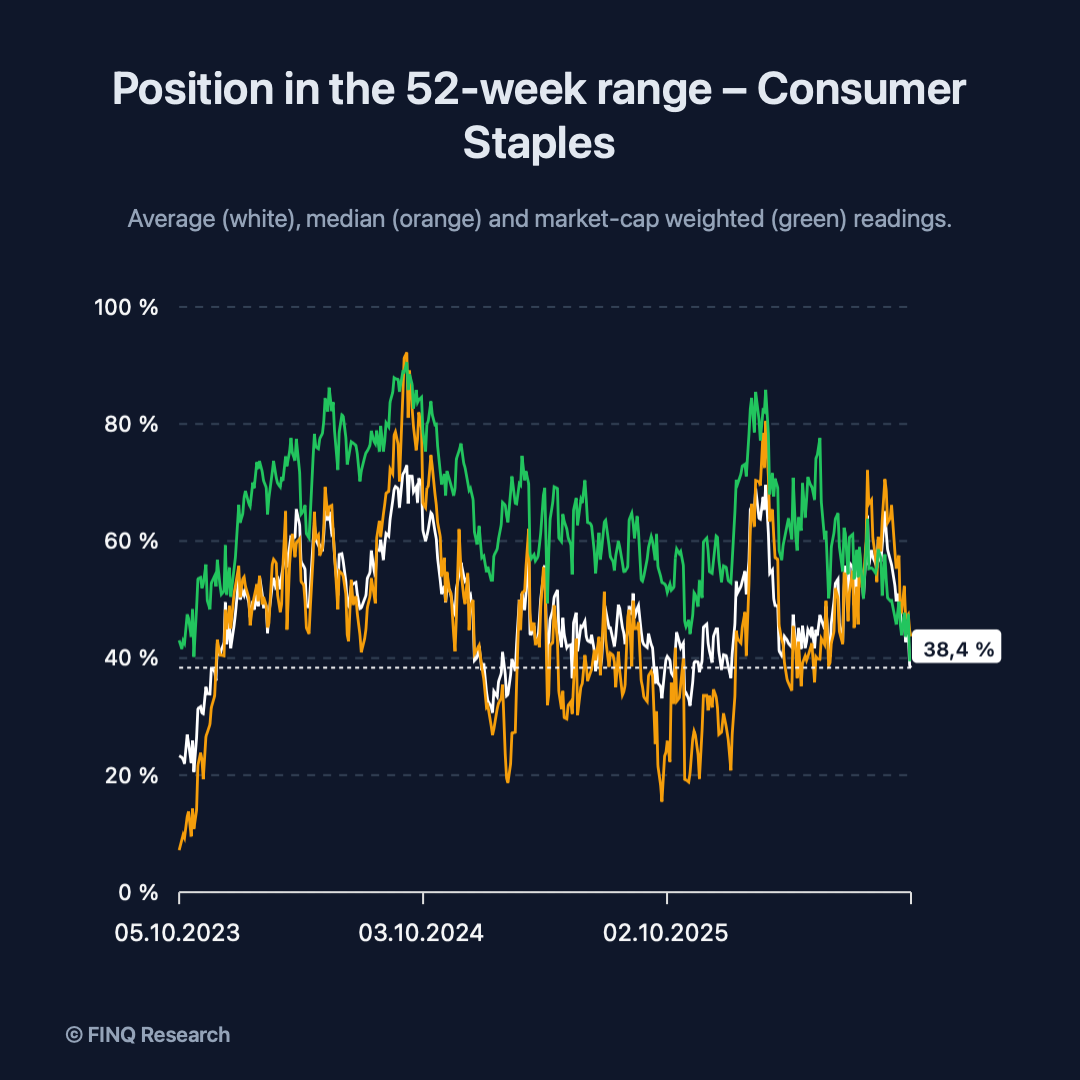
The picture becomes even clearer when looking at where individual companies are trading within their respective 52-week ranges.
The average XLP constituent is currently positioned at only around 38.4% of its 52-week range. Both the median and market-cap-weighted readings have also declined significantly and are now sitting in the lower to middle part of their respective ranges.
From our perspective, this is an important signal: weakness is not simply concentrated in a few smaller companies. A substantial part of the sector has moved away from its highs.
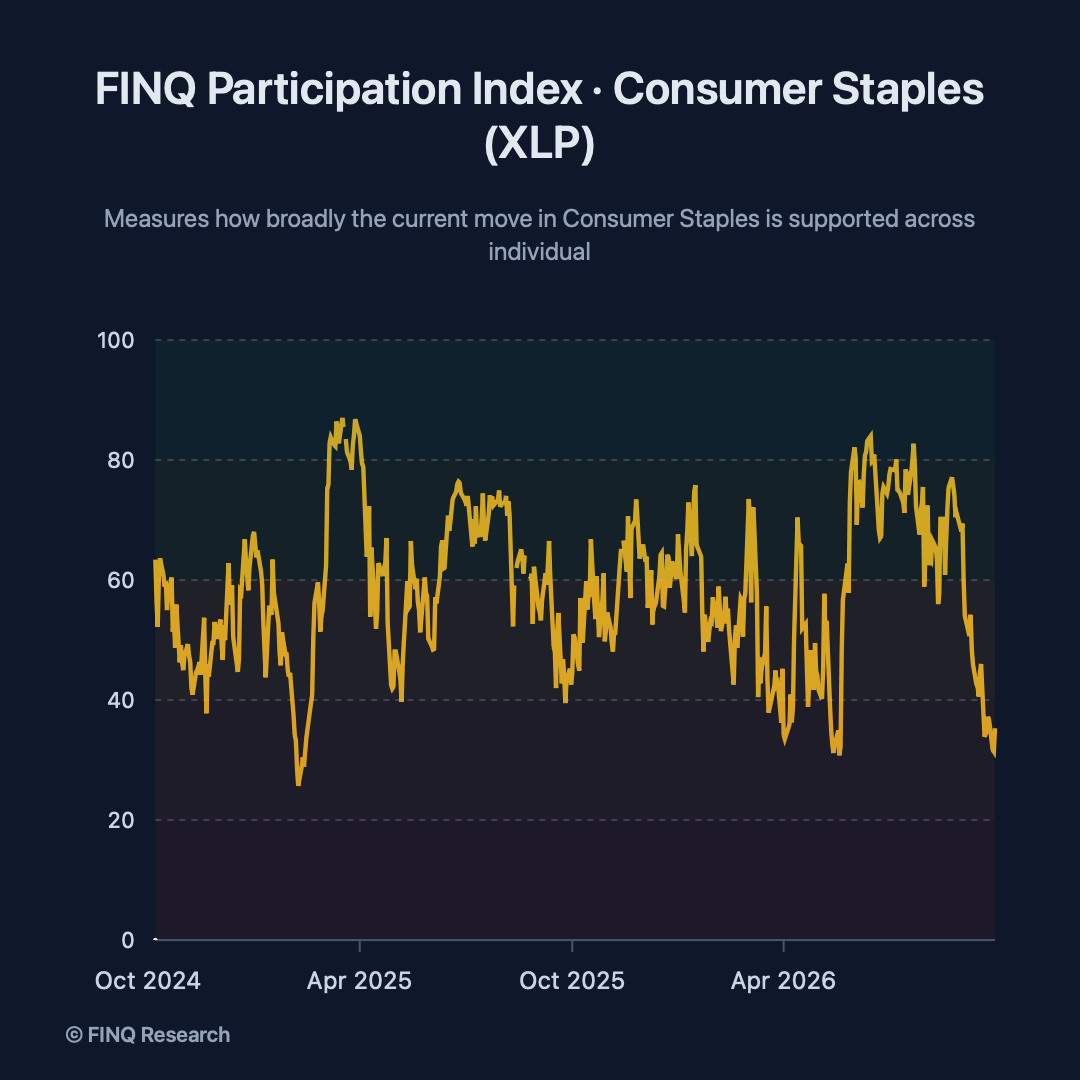
Our proprietary FINQ Participation Index confirms this picture. After temporarily trading above 80 during the summer, the index has now fallen into the low-30s.
This means that the current move is being supported by only a relatively small part of the sector. We would therefore not define a sustainable bottom solely by a stabilization in XLP itself. More important would be a renewed improvement in participation across the sector.
Major Differences Are Emerging Beneath the Surface
A look at YTD performance contributions shows just how differently individual companies are performing.
Target currently provides the largest positive contribution at around +1.92 percentage points, followed by Coca-Cola, Philip Morris, Altria and ADM. Together, these five companies contribute roughly 6.4 percentage points to performance.
On the other side, companies including Walmart, General Mills, PepsiCo and McCormick are weighing on performance.
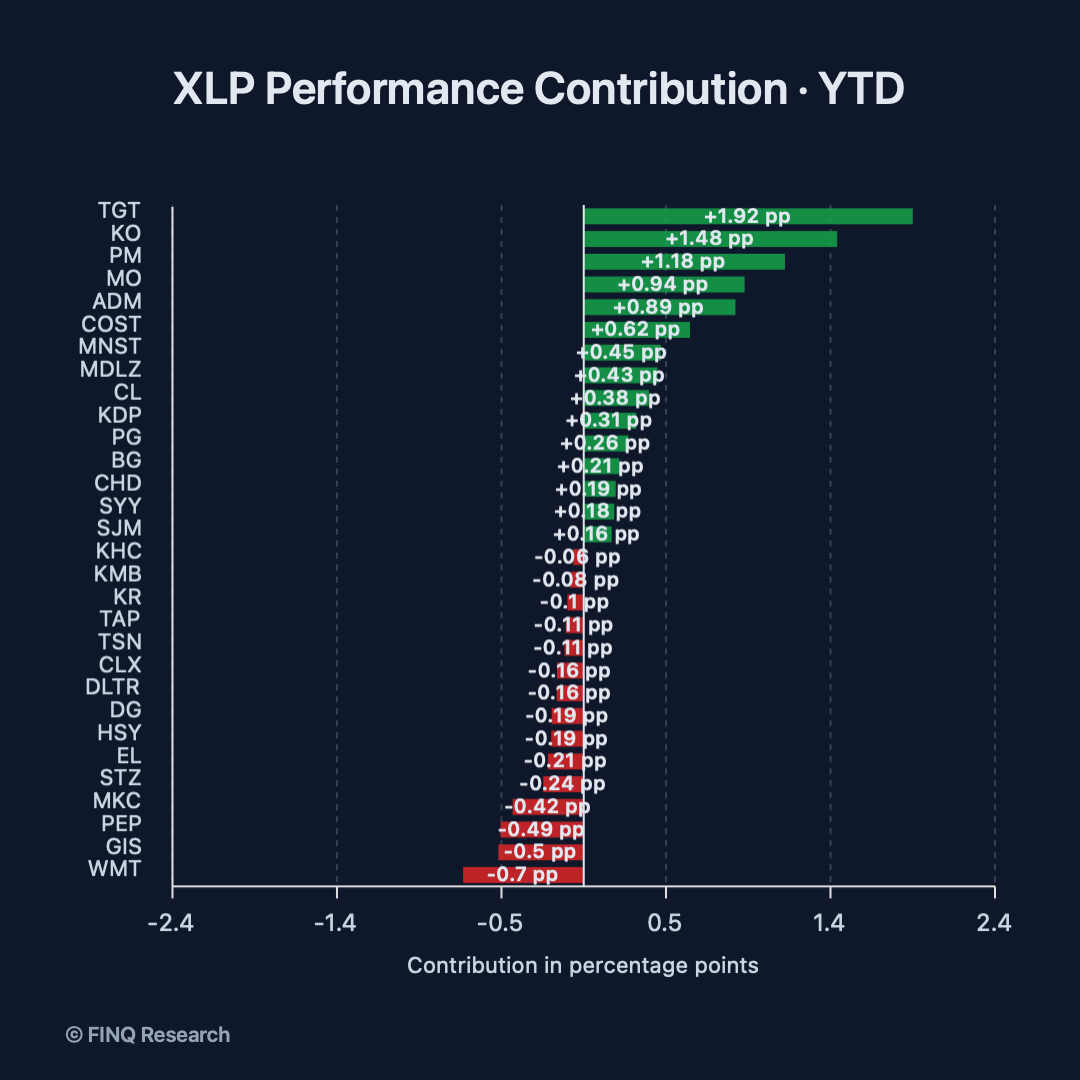
This dispersion is currently one of the most important aspects of the sector from our perspective.
Consumer Staples should therefore not be viewed exclusively as one homogeneous defensive sector at the moment. The differences between individual companies are substantial – in terms of performance, valuation and growth.
Revenue Growth Remains Solid – Earnings Could Accelerate More Strongly
Fundamentally, the picture looks considerably more stable than recent price action would suggest.
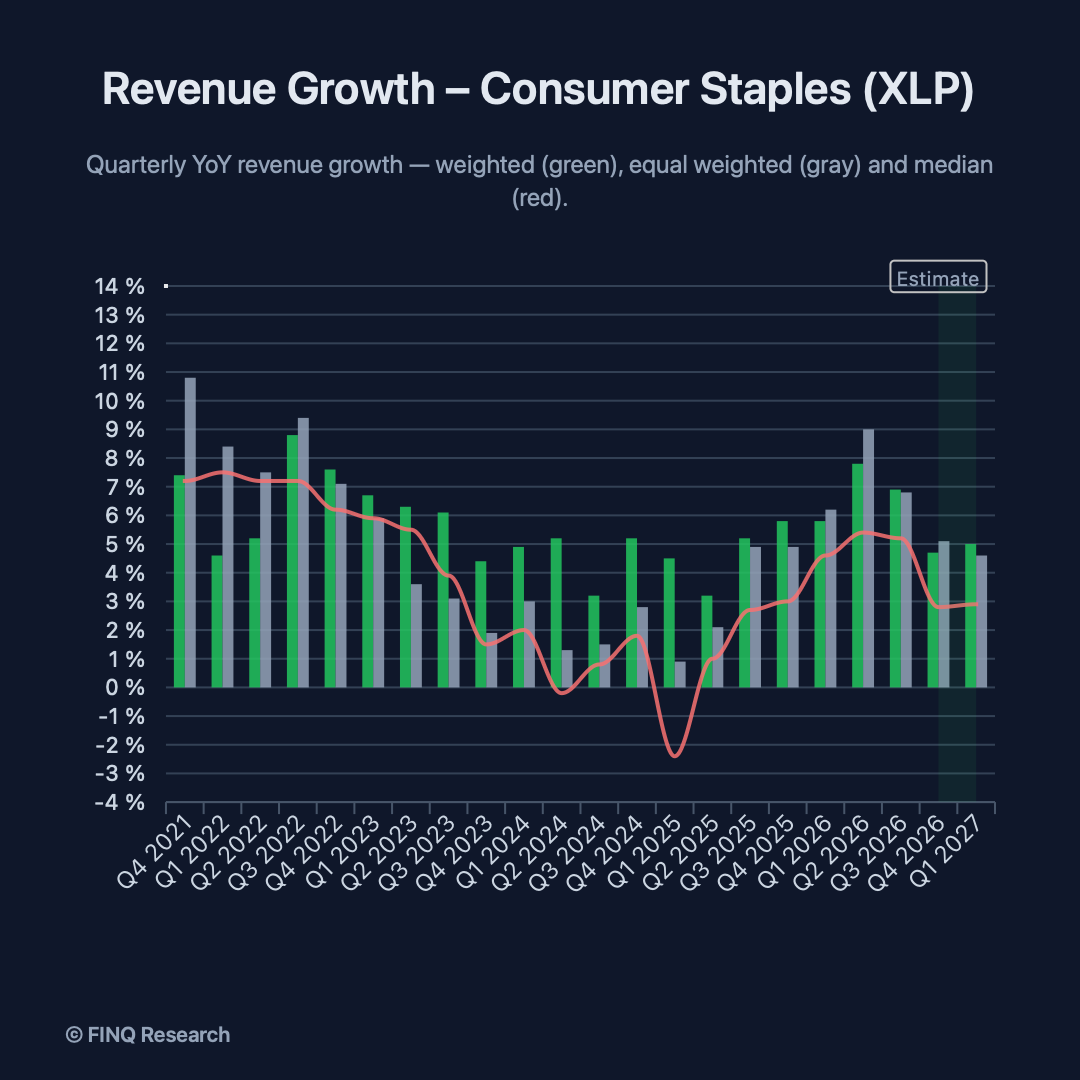
Aggregate revenue growth remains positive. For the coming quarters, market-cap-weighted expectations remain around 5% YoY, while median and equal-weighted growth are somewhat lower.
At this point, we therefore do not see a broad top-line contraction across the sector.
The earnings picture is even more interesting.
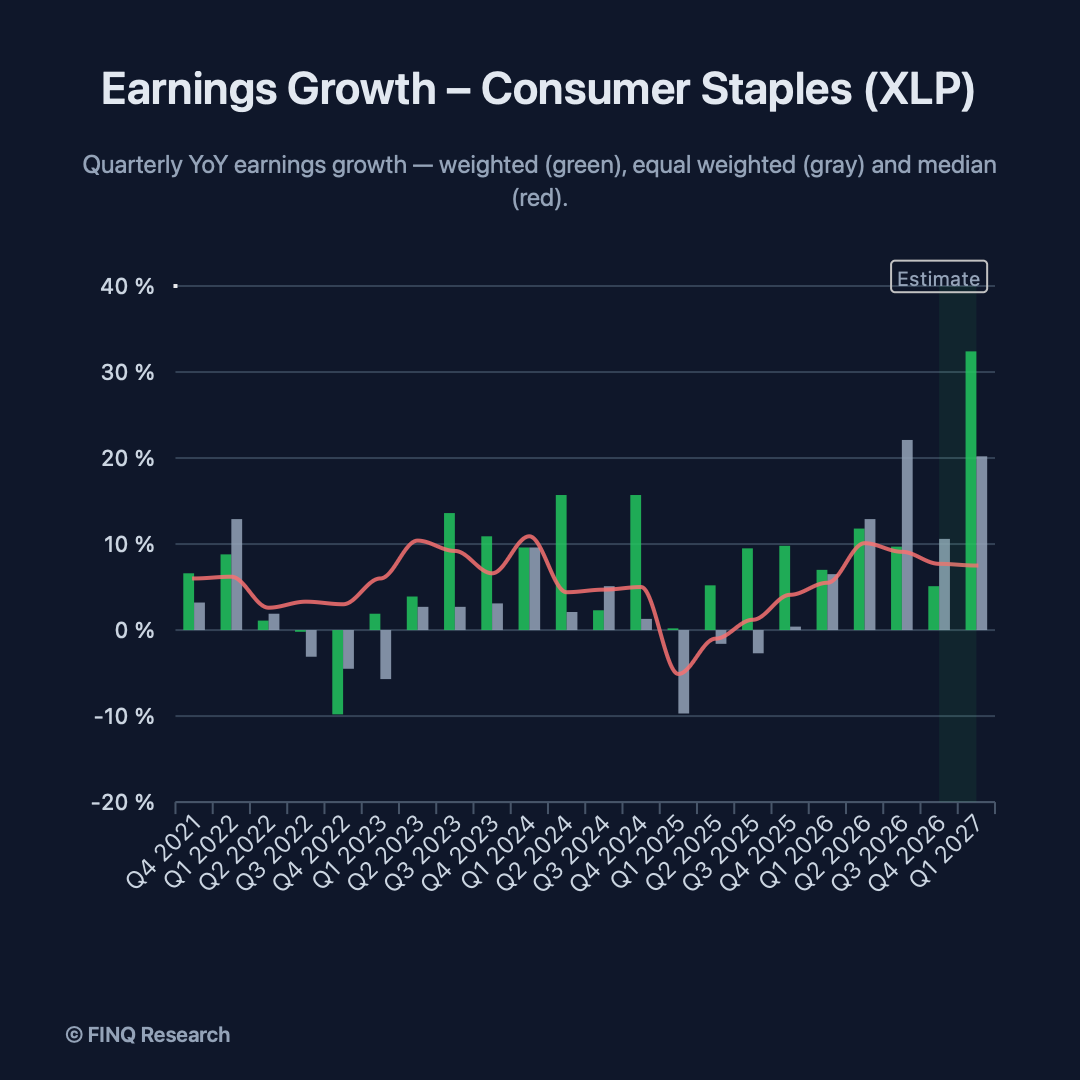
Current estimates point toward a considerably stronger acceleration in earnings growth at the beginning of 2027. On a market-cap-weighted basis, expected growth temporarily rises above 30%, while the equal-weighted measure also accelerates significantly.
The median, however, remains considerably lower at around 7–8%.
That is an important distinction.
The expected acceleration in earnings growth does not appear to be evenly distributed across the sector. Larger companies and several strong individual growth contributions are pulling the aggregate figures significantly higher.
At the same time, revenue is growing considerably more slowly than expected earnings. If these estimates prove accurate, part of the earnings growth would therefore have to come from stronger margins, operating leverage, mix effects or company-specific factors.
For us, this is one of the most important developments that will need to be confirmed during the upcoming earnings seasons.
XLP Is Not Cheap – But Many Constituents Now Are
Valuations also reveal an unusually large divergence.
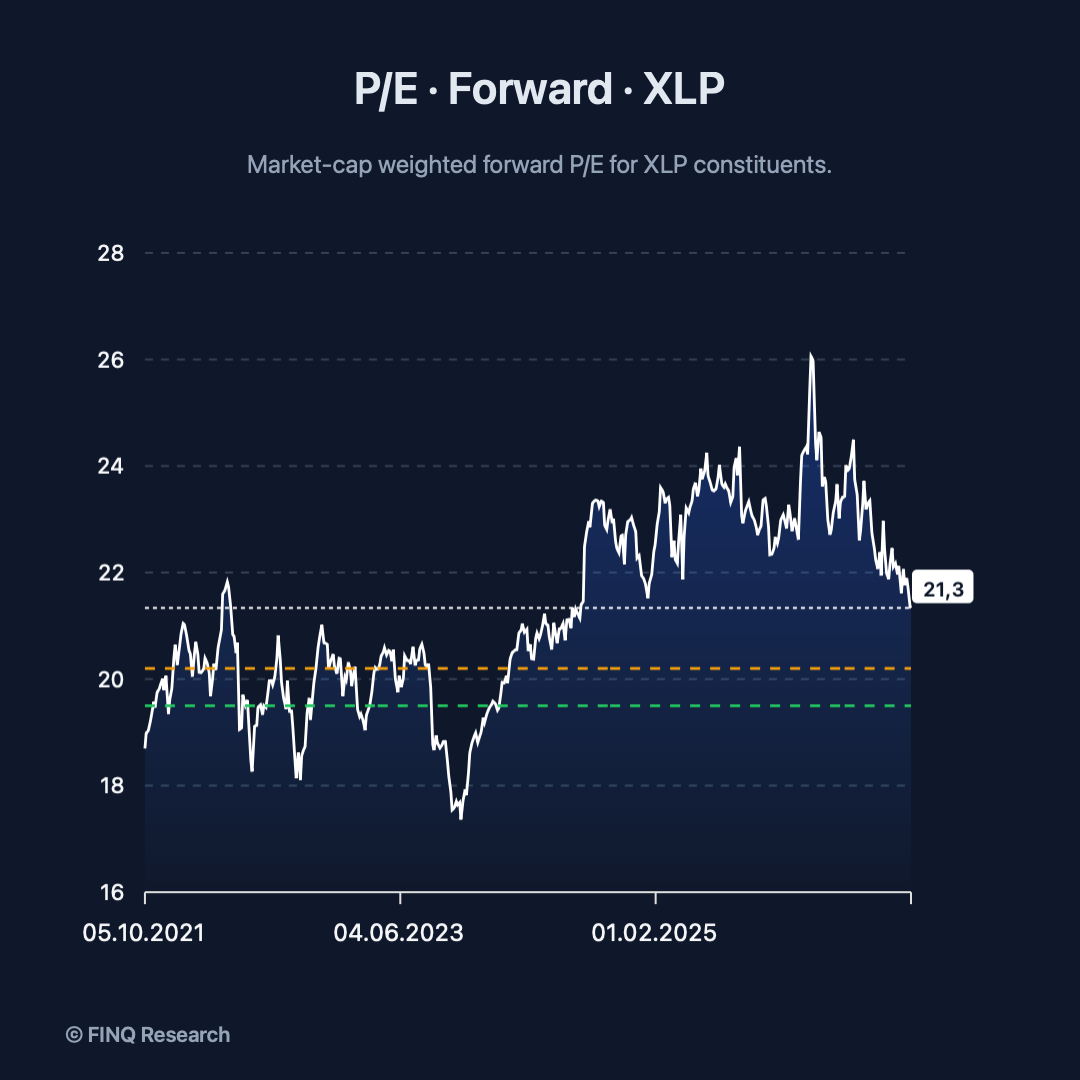
The market-cap-weighted forward P/E of XLP currently stands at around 21.3x. At the level of the largest companies, the sector has therefore come down significantly from its valuation highs, but it continues to trade above the longer-term reference levels in our model.
The equal-weighted picture looks very different.
The equal-weighted forward P/E has now fallen to around 17.4x, putting it close to the lower end of the past five years.
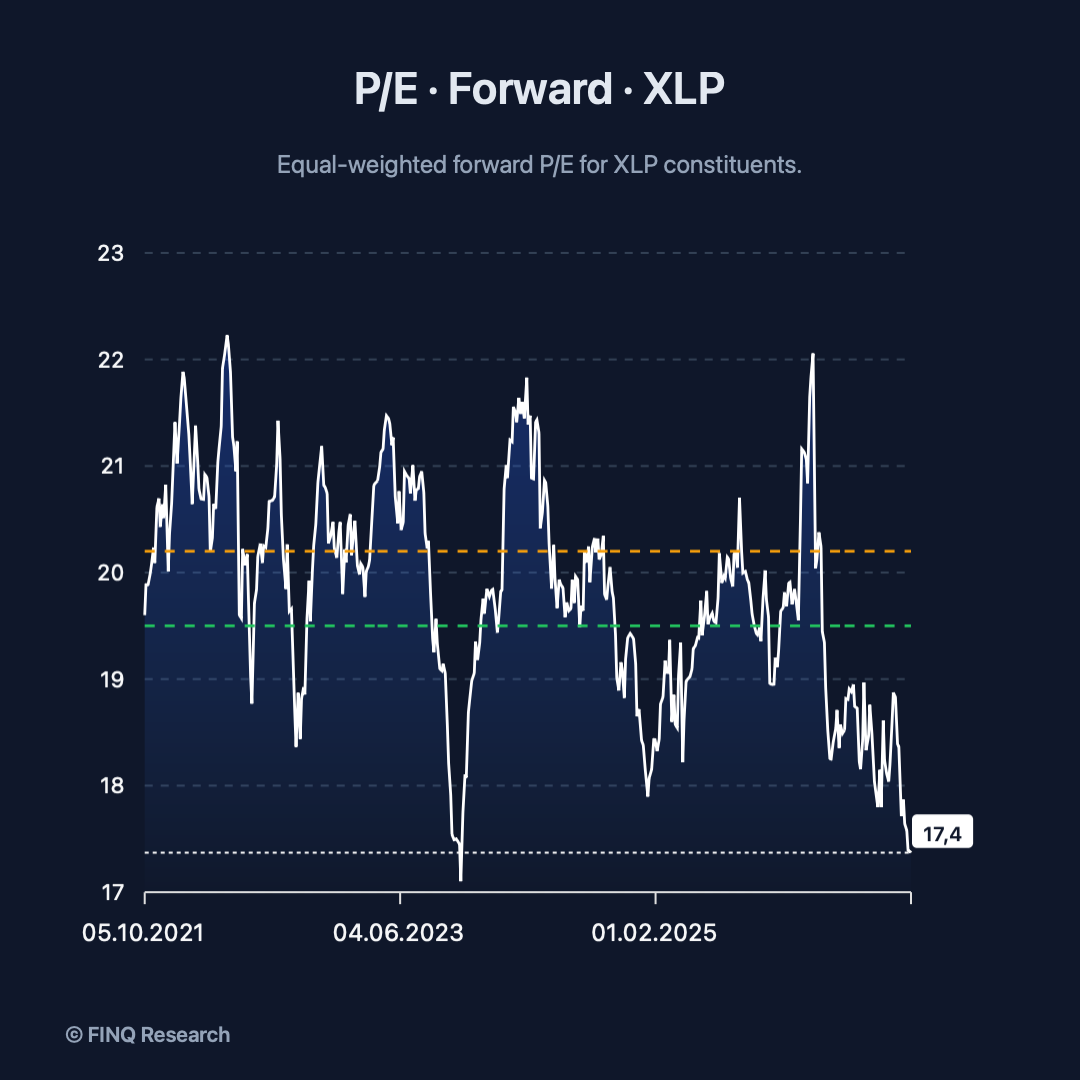
This difference between 21.3x market-cap weighted and 17.4x equal weighted is particularly relevant from our perspective.
The headline XLP multiple still makes the sector appear relatively expensive. Beneath the largest index weights, however, valuations have already compressed much more significantly.
That does not automatically mean that the sector is cheap. Instead, it shows that a considerably more interesting stock-picking environment is developing than we saw just a few quarters ago.
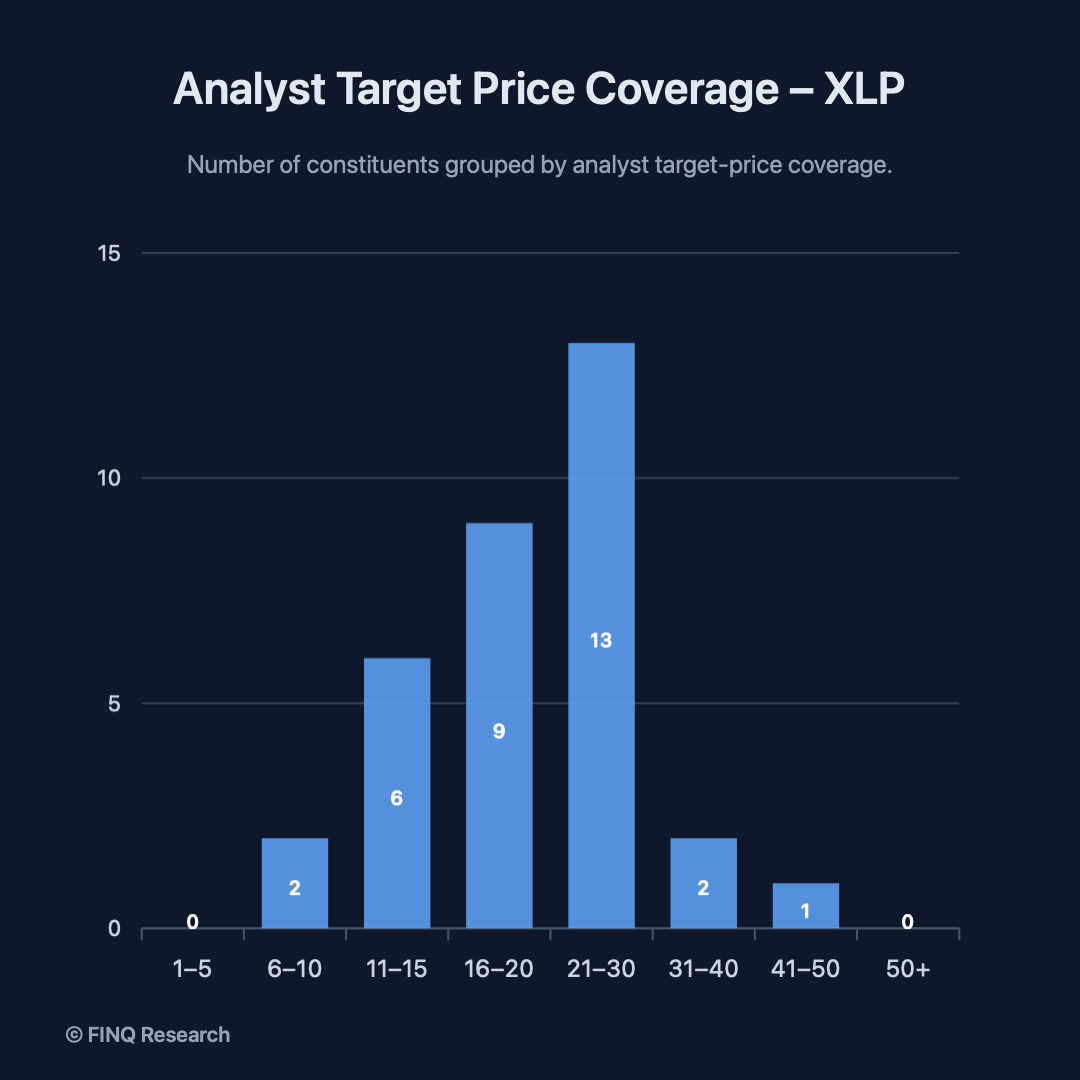
Analyst coverage is also relatively solid across a large part of the sector. 22 XLP constituents are covered by between 16 and 30 analysts, while only a small number of companies have very limited coverage.
A substantial part of the aggregate estimates is therefore based on relatively broad analyst coverage.
Volatility Is Rising – But There Is No Stress Signal Yet
The options market is also showing an interesting setup.
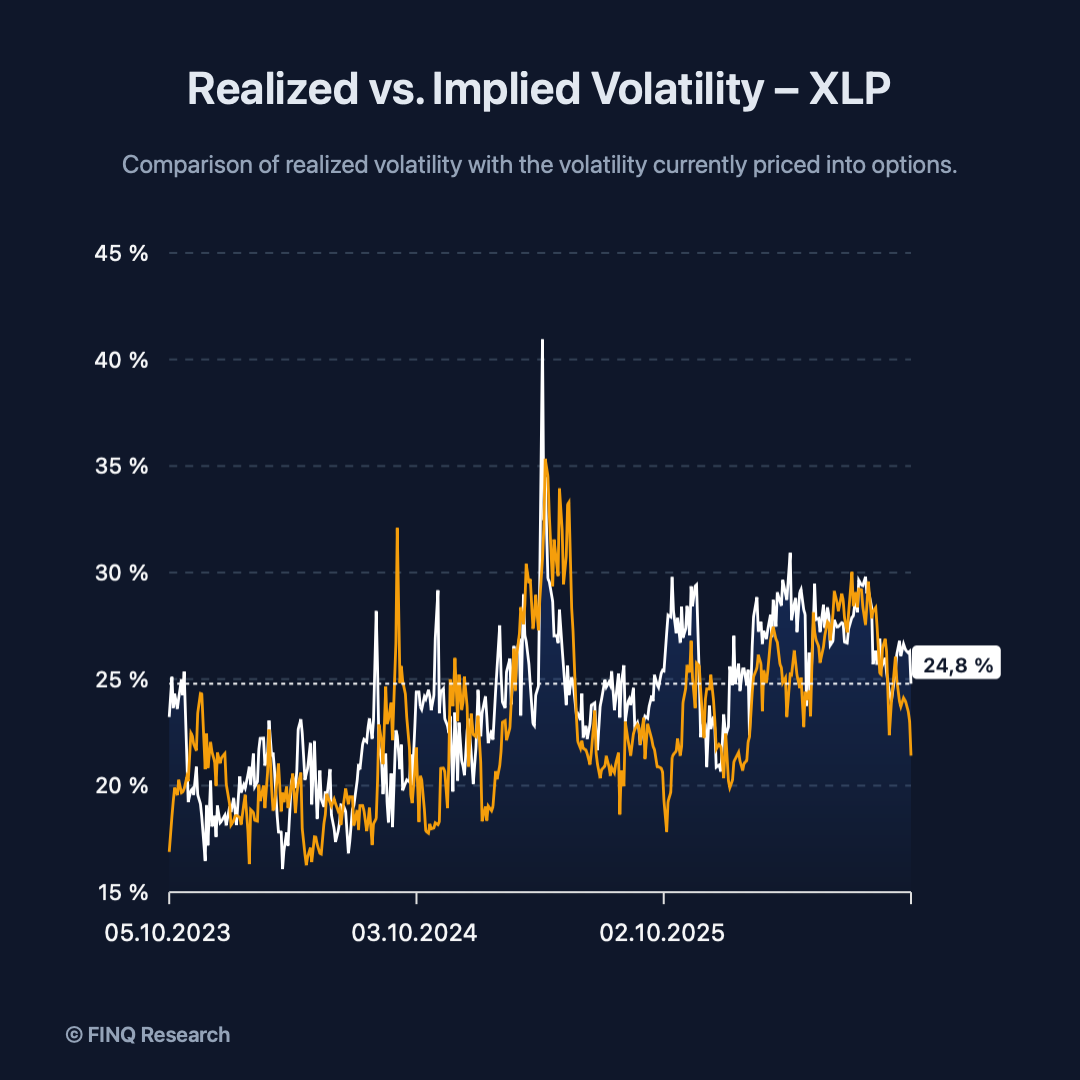
Realized volatility most recently stands at around 24.8%, above the currently lower level of implied volatility. Recent moves in the underlying have therefore been stronger than what was at times priced into options.
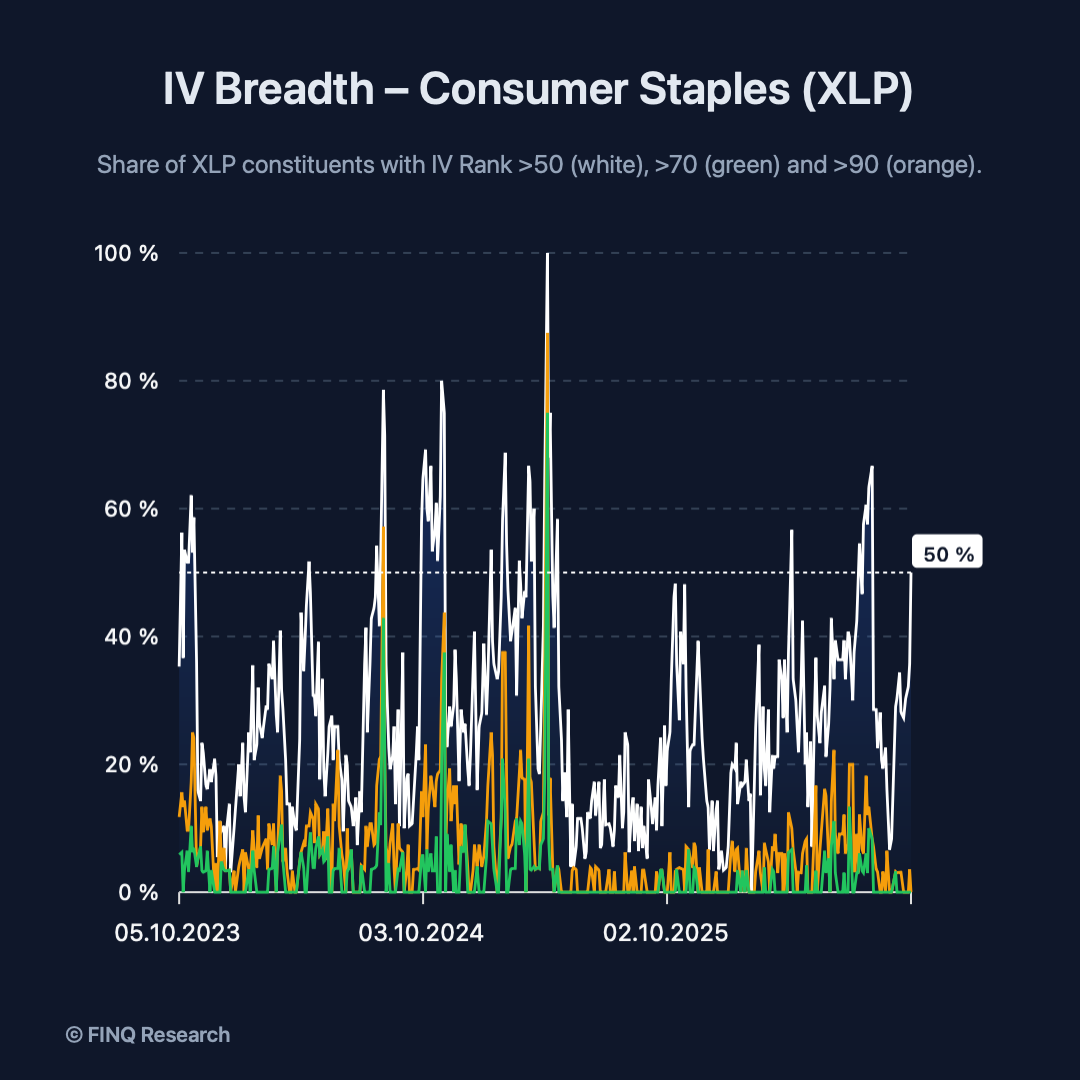
At the same time, our IV Breadth measure does not yet indicate sector-wide volatility stress.
Currently, around 50% of XLP constituents have an IV Rank above 50. At the same time, virtually no companies are above an IV Rank of 70 or 90.
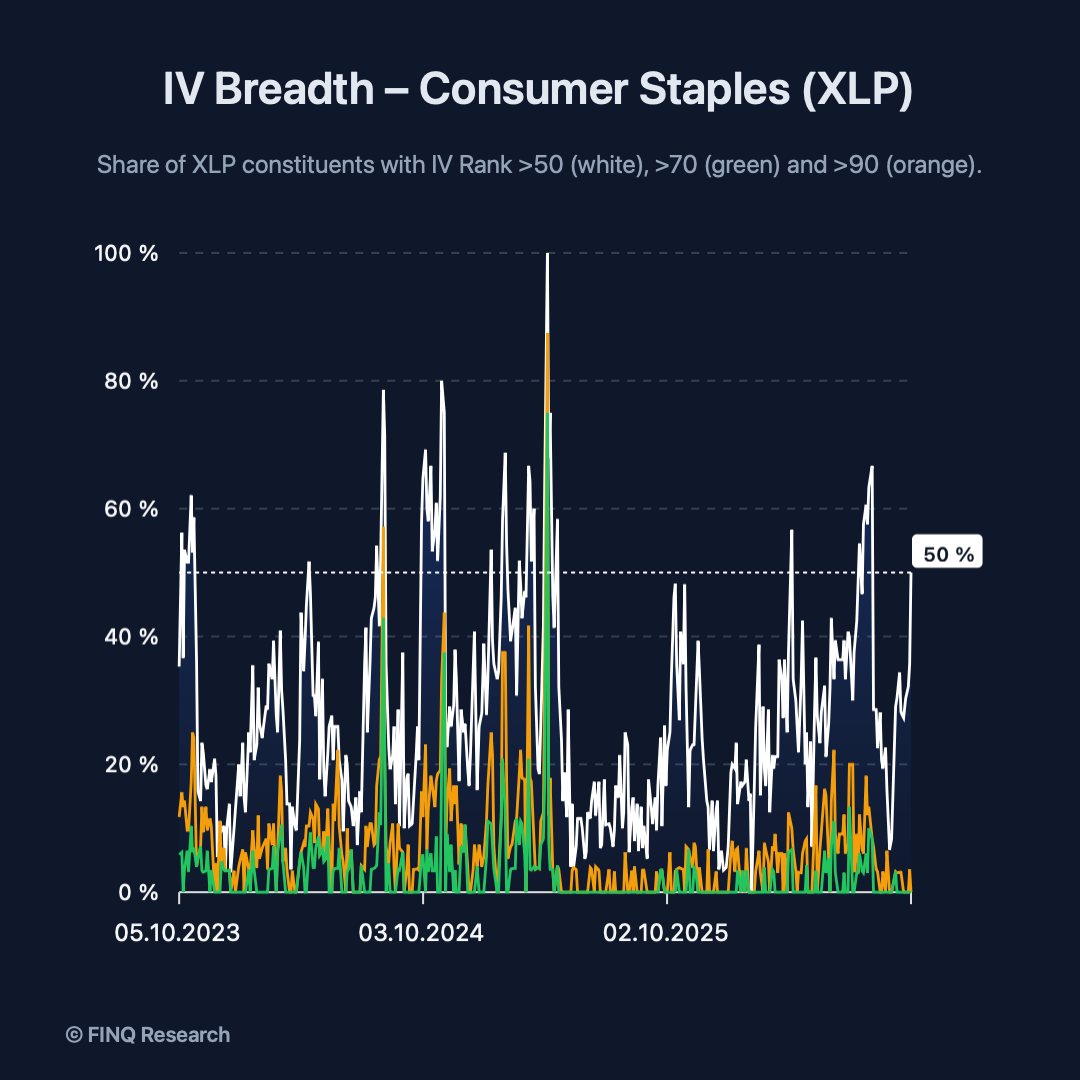
That is an important distinction: uncertainty has broadened, but it has not yet reached the extreme levels typically associated with genuine panic or a pronounced volatility shock.
We also do not currently see an exceptional escalation in aggregate options volume. The largest activity spikes of recent months are behind us, while daily activity has recently begun to normalize again.
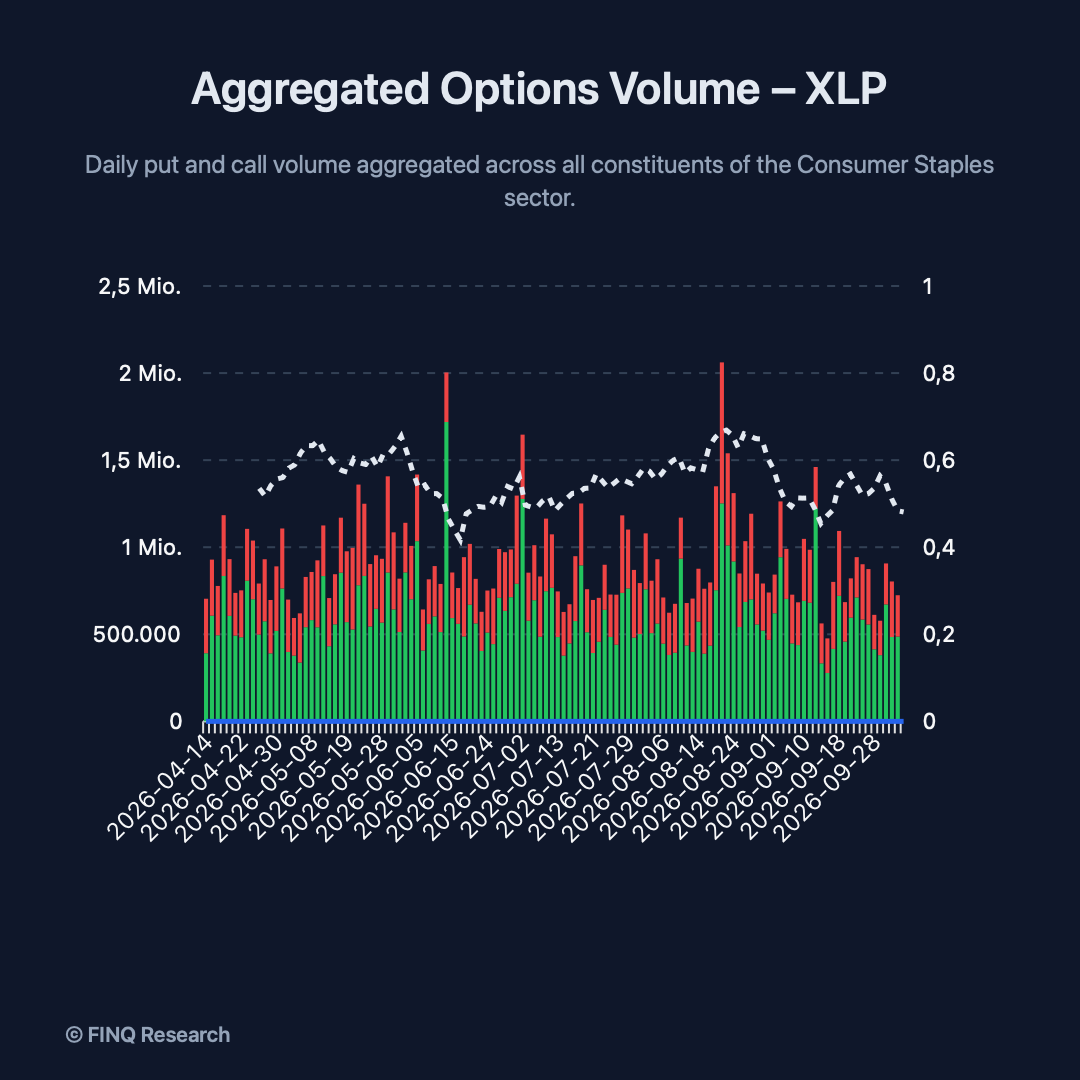
From an options perspective, we would therefore characterize the current environment as elevated uncertainty without genuine stress.
Seasonality Becomes More Interesting From Here
Another factor supports taking a closer look at Consumer Staples, at least from a historical perspective.
In our dataset, XLP’s seasonal pattern typically improves from the beginning of October. Following a weaker period in late summer, historical cumulative performance shows a considerably more positive trajectory during the final months of the year.
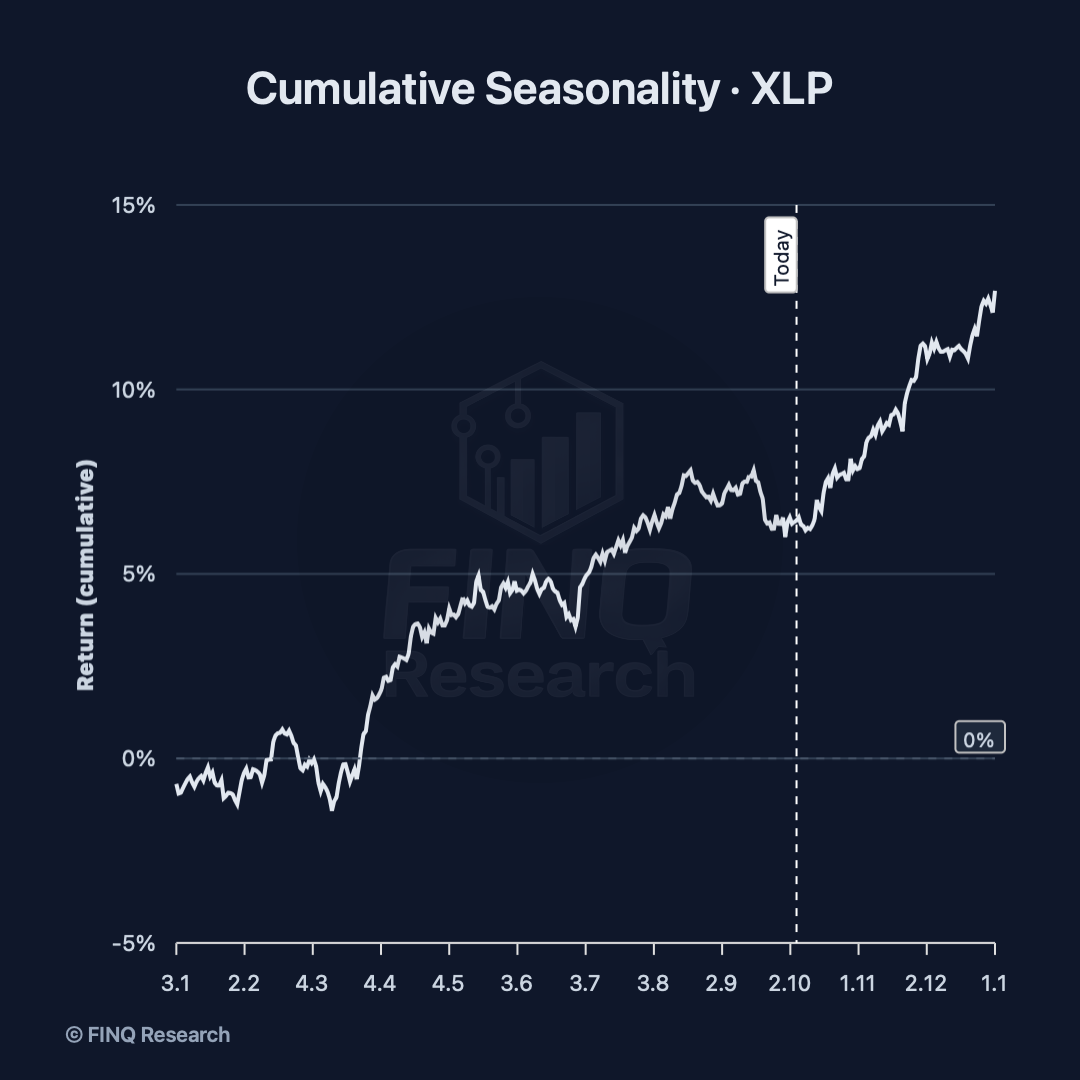
Seasonality alone is, of course, not an investment case. But combined with an already deeper drawdown, weak breadth and significantly lower valuations across many constituents, it increases the sector’s relevance for us over the coming weeks.
Our Current View
Consumer Staples are currently in an interesting transition phase.
Technically, the environment remains weak. XLP is around 8.8% below its high, market breadth has deteriorated significantly, eight companies are already in oversold RSI territory and our Participation Index has fallen into the low-30s.
That does not yet indicate a confirmed bottom.
At the same time, the fundamental picture looks considerably more stable. Revenue continues to grow, earnings estimates point toward a potential acceleration over the coming quarters and the equal-weighted valuation has fallen to 17.4x forward earnings.
For us, this does not yet create an aggressive buy signal, but it does create an increasingly interesting setup.
Three developments will be particularly important over the coming weeks:
- A stabilization in breadth – particularly in the Advance/Decline Index, RSI Breadth and our Participation Index.
- Technical stabilization around the longer-term weekly EMAs.
- Confirmation of rising earnings expectations from the companies themselves.
If internal market breadth begins to stabilize while earnings estimates remain intact, the current weakness in Consumer Staples could increasingly turn out to be an interesting reset.
If, on the other hand, earnings estimates are revised lower, the still-elevated valuation of the largest XLP constituents in particular would become more difficult to justify.
That is exactly why we are watching Consumer Staples much more closely right now.
The sector is not strong yet.
But beneath the surface, it is becoming increasingly interesting.
Disclaimer
This article is provided solely for informational and research purposes and does not constitute investment advice or a solicitation to buy or sell securities or financial instruments. Past performance, seasonal patterns, analyst estimates and market-based expectations are no guarantee of future results.