Anthropic’s IPO: Revenue Up 14-Fold — So Why an $80.75 Billion Loss?
Anthropic is growing rapidly and moving closer to operating break-even. Its enormous net loss, however, tells a different story from the underlying operating result. For investors, three questions matter: How durable is the margin improvement, how much influence will shareholders have, and what valuation will the IPO command?
Key Takeaways
- First-half 2026 revenue reached approximately $16.29 billion, around 14 times the prior-year figure.
- The operating loss narrowed to $693 million, bringing the operating margin to approximately −4.3%.
- The $80.75 billion net loss predominantly reflected valuation changes in financing instruments.
- The founders and Long-Term Benefit Trust are set to retain decisive influence.
- Without an offer price and complete capital structure, the investment case cannot yet be assessed.
Growth Is Changing the Operating Economics
Revenue is the first striking figure. Following $386 million in 2024 and $4.59 billion for the full year 2025, the supplied summary reports $16.29 billion for the first half of 2026 alone.
Against $1.16 billion in the first half of 2025, that represents approximately a 14-fold increase, or around 1,300% growth.
| Metric | H1 2025 | H1 2026 |
|---|---|---|
| Revenue | $1.16bn | $16.29bn |
| Operating expenses | $3.30bn | $16.98bn |
| Operating loss | $2.14bn | $693m |
| Operating margin | approximately −184% | approximately −4.3% |
| Net loss | $12.97bn | $80.75bn |
Operating expenses increased substantially, but significantly more slowly than revenue. The operating loss consequently narrowed by approximately 68%.
In our view, this is the most important economic development: Revenue is covering a much larger share of operating expenses. One half-year does not, however, establish a durable path to profitability.
Compute Remains Expensive but Consumes Less Revenue
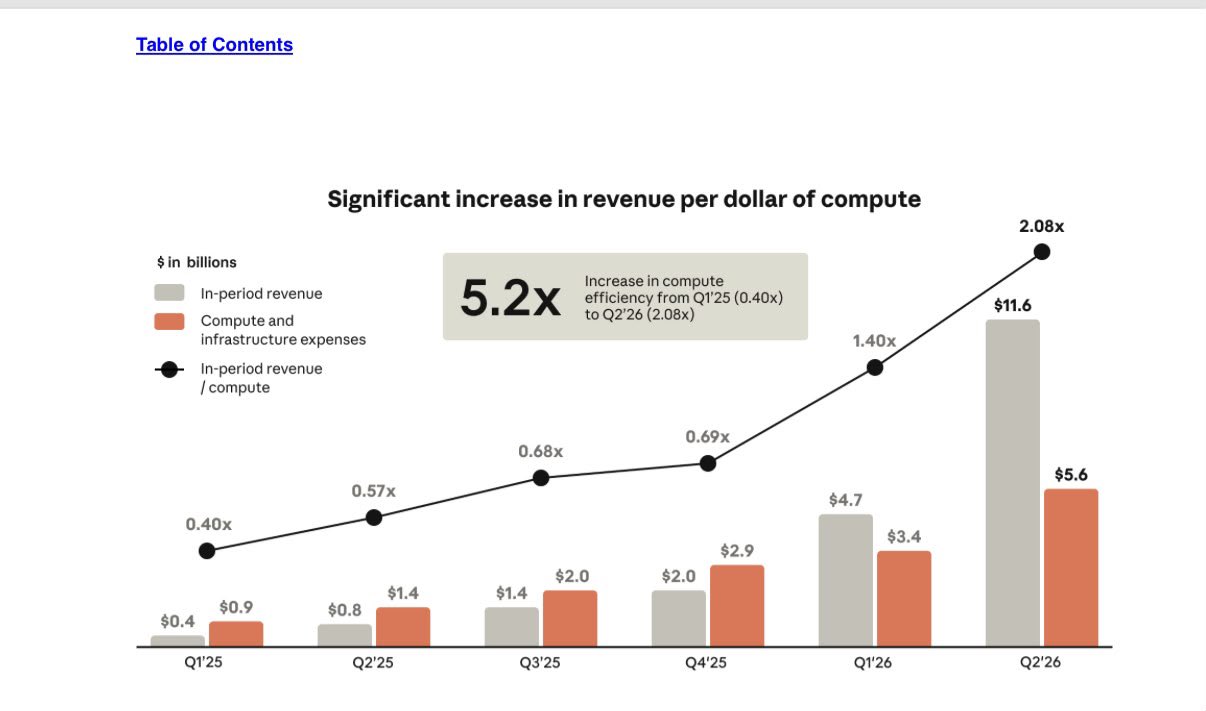
Compute and infrastructure expenses reached approximately $8.95 billion in the first half of 2026. That represents around 55% of revenue, compared with approximately 201% a year earlier.
The ratio has improved considerably. It is not a gross margin, however. Without the complete expense classification, it cannot establish the profitability of individual products or customers.
Other expense categories are also expanding rapidly. Sales, marketing and partnerships increased from $120 million to $3.17 billion. Personnel expenses reached $3.15 billion, including approximately $2.2 billion in stock-based compensation.
That compensation remains economically relevant to shareholders. It affects reported earnings without requiring an equivalent cash payment in the same period and can dilute existing ownership.
Why an $80.75 Billion Net Loss Does Not Measure Cash Burn
The gap between operating loss and net loss is exceptionally large.
According to the supplied figures, $72.39 billion arose from fair-value changes in convertible instruments, derivative liabilities and SAFEs. The summary identifies a higher company valuation as a major driver, increasing the accounting value of these financing obligations.
A rising company valuation can therefore produce a substantial accounting loss. This effect needs to be assessed separately from operating performance.
The figures also include $8.76 billion in other net expenses. The listed items do not fully reconcile to the reported net loss without additional income-statement lines. The complete statement and accompanying notes are needed to bridge that difference.
Operating earnings, net earnings and cash flow must therefore be kept separate. The supplied material does not include a cash-flow statement. Actual cash burn and a reliable liquidity runway cannot be calculated from these figures.
Substantial Liquidity Meets a Complex Capital Structure
The summary reports $131.65 billion in cash, cash equivalents and short-term investments as of June 30, 2026.
That substantial funding cushion sits alongside a complex balance sheet: $117.47 billion in liabilities and a separately presented $157.51 billion in redeemable convertible preferred stock. The reported shareholders’ deficit is $127.62 billion.
These items should not all be treated as conventional financial debt. Their redemption, conversion and participation rights matter, as do the changes scheduled to occur at the IPO.
Investors therefore need the post-IPO pro forma balance sheet and fully diluted share count to assess valuation.
Economic Exposure With Limited Influence
According to the supplied information, Anthropic plans to list on the Nasdaq Global Select Market under “ANT.” The offering is expected to include newly issued shares and sales by existing shareholders. Only newly issued shares provide fresh capital to the company.
Control is set to remain concentrated. The Long-Term Benefit Trust is expected to retain the right to appoint a majority of the board. A special Class F share is intended to give the founders 50.1% of general voting power.
Public shareholders would consequently participate in the company’s economic performance while having limited influence over its strategic direction.
Anthropic’s public benefit corporation structure adds another consideration. The company explicitly intends to consider its public purpose and affected stakeholders alongside shareholder interests. Safety decisions and other public-benefit measures may therefore take priority over additional revenue.
The Long-Term Bet Goes Beyond Automation
Anthropic’s central thesis is that AI will improve the productivity of existing work while accelerating research and innovation themselves.
The applications described span software development, business processes, medicine and public administration. These could create broad economic value. Individual examples do not, however, establish a reliable forecast for future revenue, margins or returns on capital.
For shareholders, several steps must connect: Technical capabilities must become reliable applications, customers must pay for them, and sufficient economic returns must remain after compute, distribution and further investment.
Our Assessment
The supplied figures show a substantial operating improvement. Anthropic increased revenue much faster than operating expenses and significantly narrowed the gap to operating break-even.
That does not make the stock attractive at any price. The IPO valuation, capital structure following instrument conversions, actual cash flow and durability of the margin improvement will determine the investment case.
We would focus on whether operating progress continues over subsequent quarters and how much ongoing capital the business requires. Investors must also assess the combination of limited voting influence and a corporate purpose that explicitly extends beyond profit maximization.
Sources and Methodology
https://www.sec.gov/edgar/search/#/q=ANT&sort=desc
Financial periods: full-year 2025 and the first halves of 2025 and 2026. Balance-sheet figures are dated June 30, 2026. Percentages were calculated from rounded figures; minor rounding differences are possible.
Statements about future AI capabilities and applications reflect the company’s position. They are not established forecasts by FINQ Research.
This article is for information and research purposes and does not constitute investment advice or a recommendation to buy or sell.