Global Rates: The Bond Market Is Tightening the Screws Again
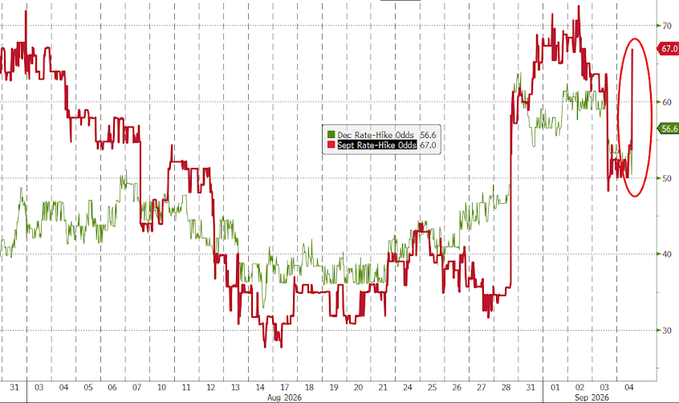
The global bond market is sending a clear signal: yields are rising again — and the latest move is part of a trend that has been building for much longer.
What makes the current environment particularly interesting is the interaction between central banks and bond markets. After the aggressive hiking cycle, many central banks started cutting policy rates again. Bond yields, however, did not follow that move to the same extent.
Don't want to miss more data-driven market insights like this? Check out our Weekly Market Recap:
https://finq-research.kit.com/cc5c1deec7
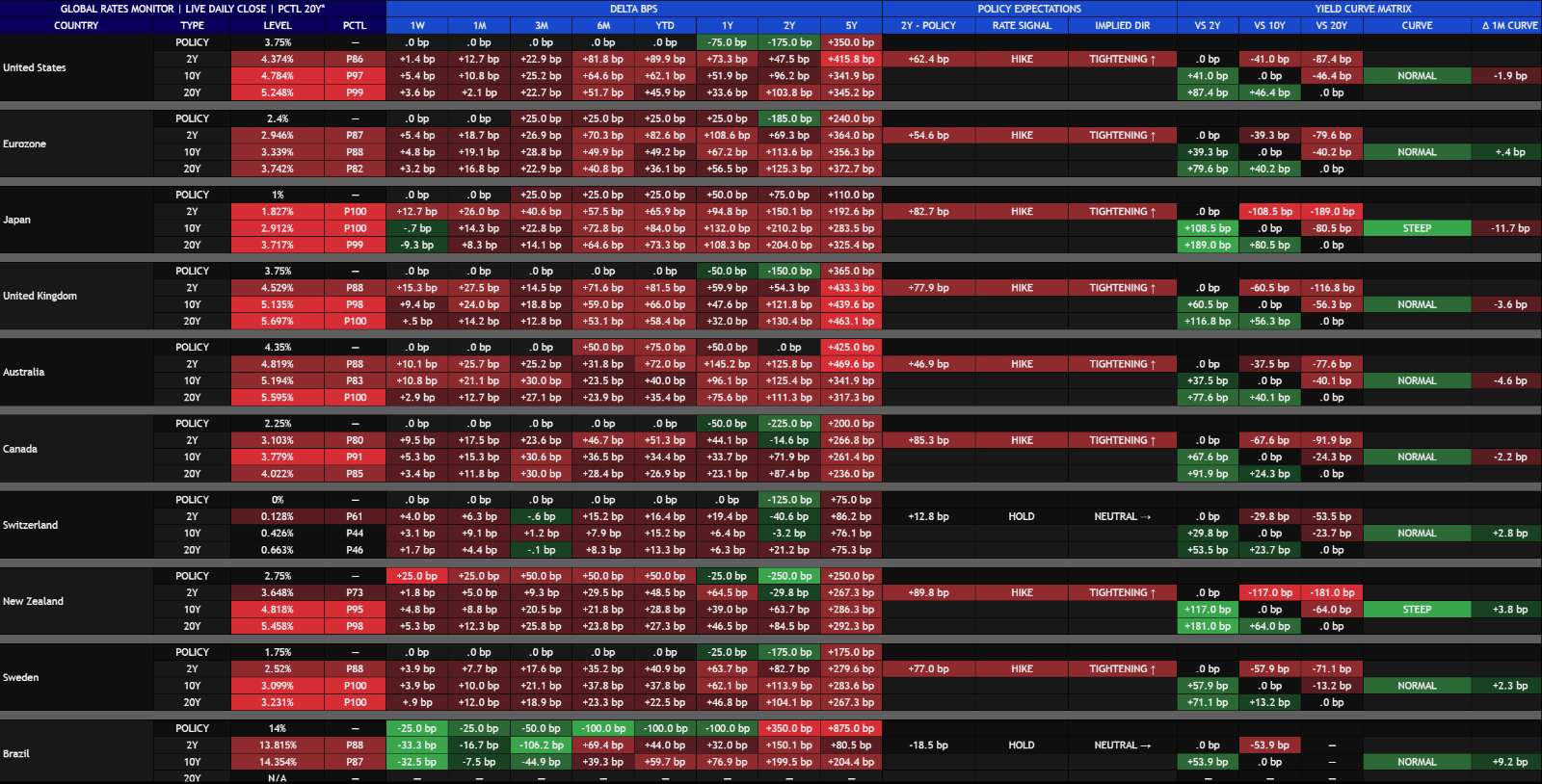
The Global Rates Monitor makes this divergence particularly visible across the 6M, YTD, 1Y and 2Y horizons. More recently, yields have accelerated higher once again.
One distinction is important from the start: policy rates and bond yields are not the same thing. Especially at the 10Y and 20Y maturities, a premium over short-term rates is historically nothing unusual. Investors generally require compensation for duration, inflation uncertainty and other risks — broadly captured by the term premium.
So the interesting part is not simply the spread between long-term yields and the policy rate.
It is the direction in which both have moved.
Central Banks Cut — Bonds Took a Different Path
Over the past two years, policy rates have fallen significantly across many developed markets.
In the US, the policy rate now stands at 3.75%, around 175 basis points below its level two years ago. The Eurozone is down 185bp, Canada 225bp, New Zealand 250bp, and Sweden 175bp.
At the same time, bond yields in many of these markets are actually higher than they were two years ago.
| Market | Policy Δ 2Y | 2Y Yield Δ 2Y | 10Y Yield Δ 2Y |
|---|---|---|---|
| US | -175bp | +47.5bp | +96.2bp |
| Eurozone | -185bp | +69.3bp | +113.6bp |
| UK | -150bp | +54.3bp | +121.8bp |
| Canada | -225bp | -14.6bp | +71.9bp |
| New Zealand | -250bp | -29.8bp | +63.7bp |
| Sweden | -175bp | +82.7bp | +113.9bp |
There is an important timing issue here.
The bond yields shown in the monitor are live market prices. They continuously adjust to inflation data, growth expectations, fiscal developments and expectations for future monetary policy.
The policy rate, by contrast, only changes when a central bank actually makes a decision. It is therefore a discrete and naturally lagging variable.
We should not read the table as central banks cutting rates and the bond market simply reacting in the opposite direction afterwards.
The bond market had already front-run a significant part of the easing cycle before central banks actually delivered those cuts.
And now, parts of that process are beginning to reverse.
That is the important signal.
The Market Is Unwinding Part of the Easing Story
The repricing becomes particularly visible over the past six months.
In the US, the 2Y yield has risen 81.8bp, the 10Y 64.6bp, and the 20Y 51.7bp.
YTD, the moves are:
2Y: +89.9bp · 10Y: +62.1bp · 20Y: +45.9bp
The front end has been particularly aggressive.
The US 2Y now trades at 4.374%, compared with a policy rate of 3.75%. Similar setups can be seen across the Eurozone, Japan, the UK, Canada, Australia, New Zealand and Sweden.
Again, a positive 2Y-policy spread alone does not automatically signal an imminent rate hike. The 2Y yield reflects the expected average policy path over the coming two years, alongside various risk premia.
What matters more is the change in that spread and the direction of the 2Y yield itself.
When the 2Y rises sharply while the current policy rate remains unchanged, the market is effectively saying:
The expected future path of interest rates needs to be higher than previously assumed.
That is why the conversation is gradually shifting away from “How many cuts?” toward “How much room is actually left to cut?”
The Long End Is Telling an Even Bigger Story
With the 10Y and 20Y, we need to be even more careful when comparing yields directly with the policy rate.
Longer-duration bonds carrying a premium over short-term rates is not unusual by itself.
What matters is how that premium is changing — and what is driving it.
The US 10Y now trades at 4.784%, while the 20Y stands at 5.248%. In the UK, the 10Y is at 5.135%, Australia at 5.194%, and even Japan's 10Y has reached 2.912%.
At the long end, the story extends far beyond the next central-bank meeting.
Long-term inflation expectations, growth, fiscal deficits, government bond supply and the term premium all become increasingly important.
Central banks can lower the overnight rate.
But they cannot guarantee that investors will be willing to lend governments money for ten or twenty years at substantially lower yields.
Japan Remains the Extreme Case
Japan provides perhaps the clearest example of how much the global rates regime has changed.
With a policy rate of 1.0%, the Japanese 2Y trades at 1.827%, the 10Y at 2.912%, and the 20Y at 3.717%.
Over two years, yields have risen by roughly:
2Y: +150bp · 10Y: +210bp · 20Y: +204bp
Japan is therefore a somewhat different story from the US or Europe.
Rather than being primarily about cuts that failed to pull bond yields lower, Japan represents the continued normalization of a rates market that spent decades under extremely low or negative interest rates.
Higher domestic Japanese yields change the relative attractiveness of foreign bonds for Japanese investors while also changing the economics of yen-funded carry trades.
What happens in JGBs does not necessarily stay in Japan.
The Bigger Picture
The key message from the Global Rates Monitor is therefore not that long-term yields are trading above policy rates.
That, by itself, would be nothing unusual.
The more interesting signal is the sequence of events.
Central banks have significantly lowered policy rates over the past two years. Bond markets anticipated much of that easing before the cuts were actually delivered. But instead of continuing lower afterwards, 2Y, 10Y and 20Y yields across many markets have moved higher again — with the latest move showing renewed momentum.
This suggests that markets are reassessing both the future path of policy rates and the price investors demand for holding long-duration bonds.
That tension between policy rates, market expectations and term premium may be the most important story behind the current move in global rates.
Disclaimer
This publication is provided for informational and research purposes only and does not constitute investment advice, financial advice, or a recommendation to buy or sell any financial instrument. All views are based on information available at the time of publication and may change at any time.